
A business model canvas can be defined as a short one pager business plan, it basically lays the foundation of your business because it focuses on these key areas- your Customers, Revenue streams, Distribution, Value proposition, Key Resources, Activities, Partnerships and your Cost-structure.
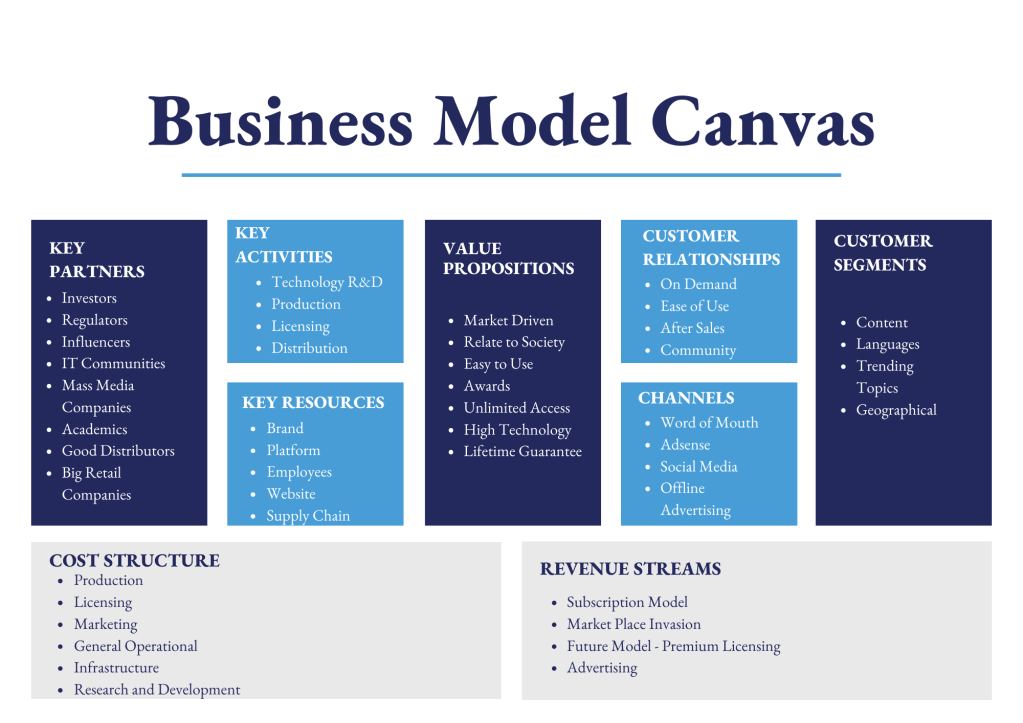
The business model canvas clearly defines the demand-generation side (internal factors) on the left and the fulfilment of supply (external factors) on the right for any business be it a product or a service. These two sides are split around the value proposition as shown below.
This canvas or one-pager document helps entrepreneurs and founders create a link between their idea and the business they intend to build. It allows everyone to get a clear idea of what a business would look like.
While filling the business model essentially we should try filling the Right side (external factors) first; that is, the Value Proposition, the Customer Segments, Customer Relationships, Channels and Key Activities.
The Value Proposition, clearly defines the problem you intend to solve with your service or product business, it also helps you understand which customer or clientele will be your target market and the problem you’re solving will resonate with which audience, helping you build a story around your brand, product or service.
The next part of the business model canvas is Customer segmentation which you would have figured through your value proposition and the customer relationship areas will be the various touchpoints your customer can interact with you and your business through the story about the problem you intend to solve.
Through the value proposition, you would also be able define your customer personas and where are you most likely to find them, these would help you find the right channels for distribution. These channels for distribution will enable you to find your revenue streams. These Revenue streams also provide an indication on your pricing structures; pay per product/view, freemium model, subscription-based, fixed rate, fees, etc. This
Once you have found these channels, your next step would be defining the key activities that would help you establish your presence on these channels, is it on social media, radio, TV, via print, etc.
Once you have filled this right side (external factors) for your business model canvas it is now time to move on to the left side (internal factors) for your business that is the Key Resources, Key Partners or Cost structures
The Key activities will help you define the key resources that you will need to perform those activities, be it people, tech or AI, office spaces, research, etc.
Your Key Partners would ideally be your suppliers, external business parties that you would need to achieve your key activities and deliver your produce or service in terms of value to your customer.
And finally define your cost structure, that is how much is it going to cost you to deliver your product or service, the cost structure clearly defines major costs such as legal, raw material, equipment, etc. these should essentially be covered in your pricing model for your product or service.
The Business Model Canvas helps paint a clearer picture in an entrepreneurs’ mind as it clearly chalks down a clear path to the future of the business model linking every single element that is necessary for the business to survive. This concept was developed by Alexander Osterwalder and Yves Pigneur in the year 2004 along with many practitioners and was based on The Business Model Ontology developed by Alexander Osterwalder.
 Your Gambit
Leave a comment